
Worried about a neighbour
Post piling up, curtains that stay closed, a neighbour wandering the street at night or a smell in the hallway. You are worried, but knocking feels intrusive and doing nothing feels wrong. Sometimes there’s noise or disturbance too, but it doesn’t feel like an ordinary complaint.
Describe only what you see yourself, without labels or diagnoses, and offer something small and specific: bringing in post, a cup of tea, knocking now and then. Ask whether there’s someone you can contact if you’re worried. Your neighbour is also free to say they are fine.
The example messages and the incident diary help you make contact calmly and share your concern honestly. You are a neighbour, not a care worker; keep an eye on your own limits and leave the decisions with your neighbour as long as there is no danger.
What do the rules say?
As a neighbour you have no legal duty to arrange care, and an adult may refuse help as long as they can make that decision and there is no serious danger. You can share your concern: in England every council has an adult social care or safeguarding adults contact, and self-neglect counts; under section 42 of the Care Act 2014 the council must make enquiries where an adult with care needs is at risk of abuse or neglect. NHS 111 can advise on health worries that are not an emergency, and 101 can arrange a police welfare check. Professionals are bound by confidentiality. In immediate danger call 999.
How to approach it
1. Note what you saw yourself, with date and time, and keep observation and suspicion apart.
2. Leave a short, friendly note or have a word on the doorstep, and offer one specific thing.
3. Agree something small and ask for a named contact in case you’re worried.
4. Still worried? Say honestly that you are asking adult social care or NHS 111 for advice. In immediate danger, don’t wait: call 999.
Tips for your message
Describe the letterbox, not the person. A sentence like ‘I noticed your post has been piling up for a few days and wondered how you are’ works better than ‘I think you need help’. Keep your offer small and realistic, and say honestly what you can and cannot do.
This is general information, not legal advice.

Pack
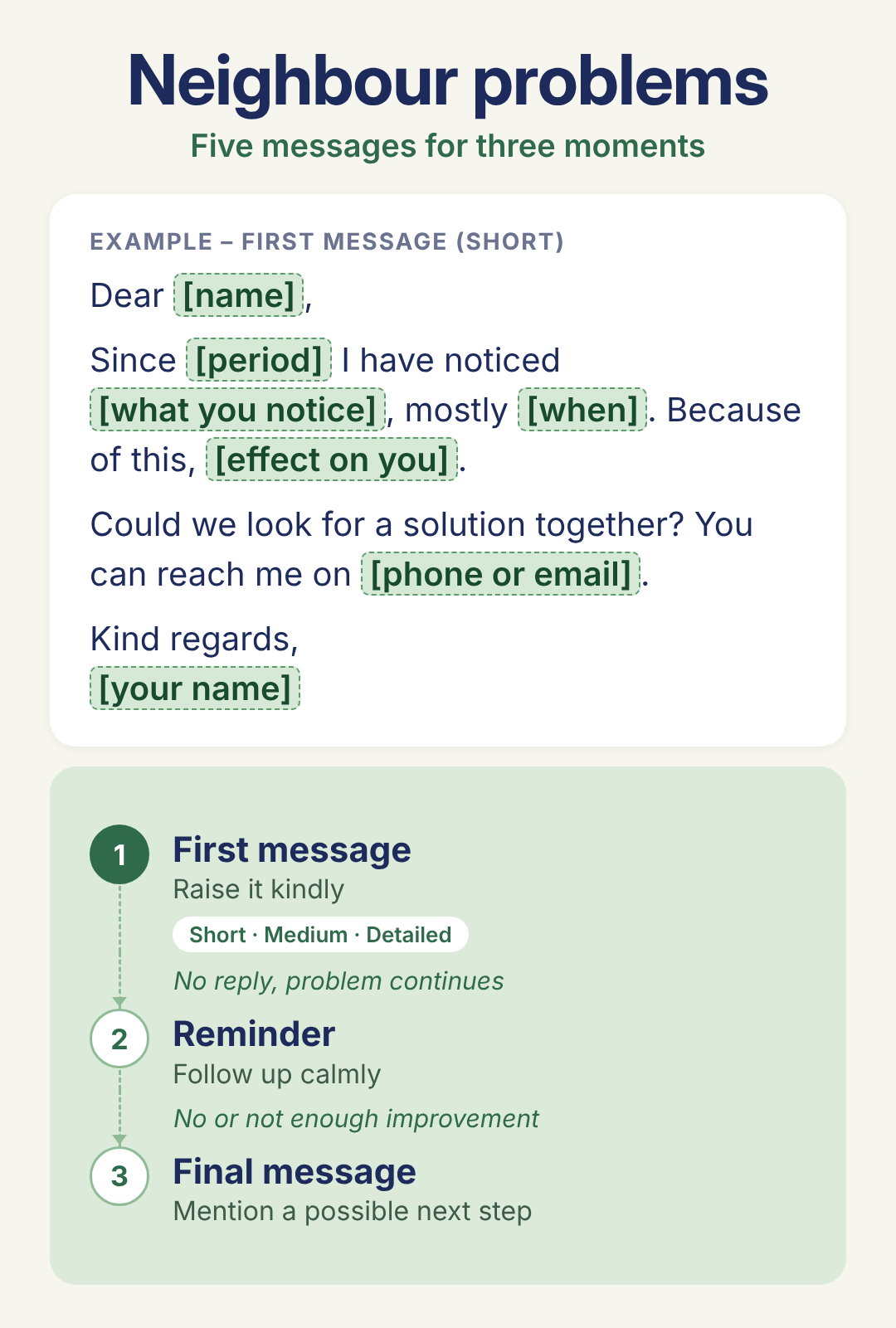
Five example messages: a first message in three lengths (short, medium and detailed), a reminder and a final message, a guide to choosing and using them, background information and UK context, and an incident diary (Word, plus a free Excel version).
The image shows a general example; the messages in the pack are tailored to this situation.
Why CalmNotes?
Based on experience with neighbour problems and community mediation
Focused on de-escalation
Ready to use straight away
Choose an appropriate step. If contact feels unsafe, seek help first.