
Cannabis smell
The smell of cannabis is strong, distinctive and lingers in curtains, clothes and bedding. Through an open window, a balcony, the stairwell or a shared ventilation duct it easily reaches the neighbours, while the person smoking usually doesn’t notice.
Your message is about the smell in your home and what it means for you, not about what your neighbour does in theirs. Ask for a small, realistic arrangement, such as not smoking at an open window or on the balcony when your windows are open.
The example messages and the incident diary help you talk this through calmly and keep track of what you agree. Only use facts you know and leave room for the other person to explain.
What do the rules say?
Cannabis is a Class B controlled drug, and possessing or growing it is generally an offence; that is a matter for the police, not for neighbours. Smoke from a home can in theory be a statutory nuisance, but many councils say cannabis smoke from a home is not normally treated as one. Tenancy agreements and leases often contain terms on nuisance and anti-social behaviour.
How to approach it
1. Note a few times when you smell it, how long it lasts and where it comes in.
2. Send a friendly message with one specific suggestion, such as no smoking at an open window after an agreed time.
3. Agree a date to check together whether it helps.
4. Nothing changes? A community mediation service, the landlord or the managing agent can help, especially if the smell comes through the ventilation.
Tips for your message
Don’t accuse; describe what you smell. A sentence like ‘When someone smokes on the balcony in the evening, the smell comes in through our bedroom window; could we look at what might help?’ usually works better than ‘You’re smoking weed all day’. If you suspect cultivation, don’t raise it with your neighbour; report it to the police on 101 or to Crimestoppers.
This is general information, not legal advice.

Pack
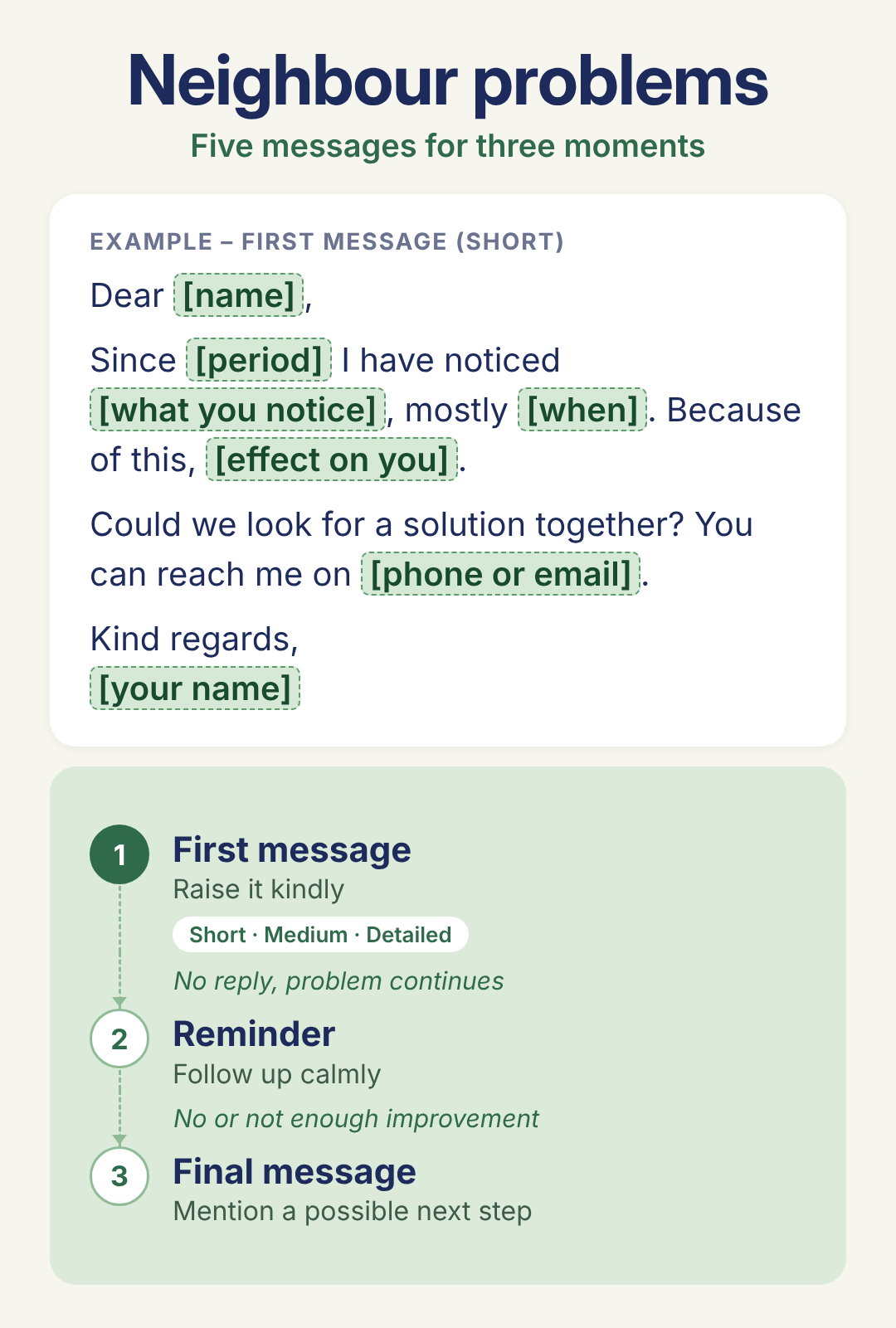
Five example messages: a first message in three lengths (short, medium and detailed), a reminder and a final message, a guide to choosing and using them, background information and UK context, and an incident diary (Word, plus a free Excel version).
The image shows a general example; the messages in the pack are tailored to this situation.
Why CalmNotes?
Based on experience with neighbour problems and community mediation
Focused on de-escalation
Ready to use straight away
Choose an appropriate step. If contact feels unsafe, seek help first.