
Fences and boundaries
A fence between two gardens is about more than timber and posts. It touches on money, privacy and where your garden ends, so a broken fence or a plan for a new one can quickly become sensitive.
Describe what you can see yourself and make a specific suggestion, such as looking at the damage together, getting quotes or sharing the cost. Don’t start work on the fence before you have agreed something.
The example messages and the incident diary help you talk this through calmly and keep track of what you agree. Only use facts you know and leave room for your neighbours’ view.
What do the rules say?
In England and Wales there is generally no rule that you own the fence on your left or right. Your deeds may say who maintains it: a “T” mark on your side usually means you do. A fence up to 2 metres high normally needs no planning permission. Title plans usually show only general boundaries, and HM Land Registry cannot settle boundary disputes; a boundary agreement can record what you agree.
How to approach it
1. Take dated photos from your own property and note what the problem is.
2. Send a friendly message with one specific suggestion, such as getting quotes together.
3. Put what you’ve agreed in writing: what, where, who pays what and when.
4. Can’t agree? A community mediation service or RICS mediation can help, or the landlord if you rent.
Tips for your message
Don’t accuse; describe what you see. A sentence like ‘After the storm two panels are leaning; shall we look at what to do together?’ usually works better than ‘Your fence is falling down’.
This is general information, not legal advice.

Pack
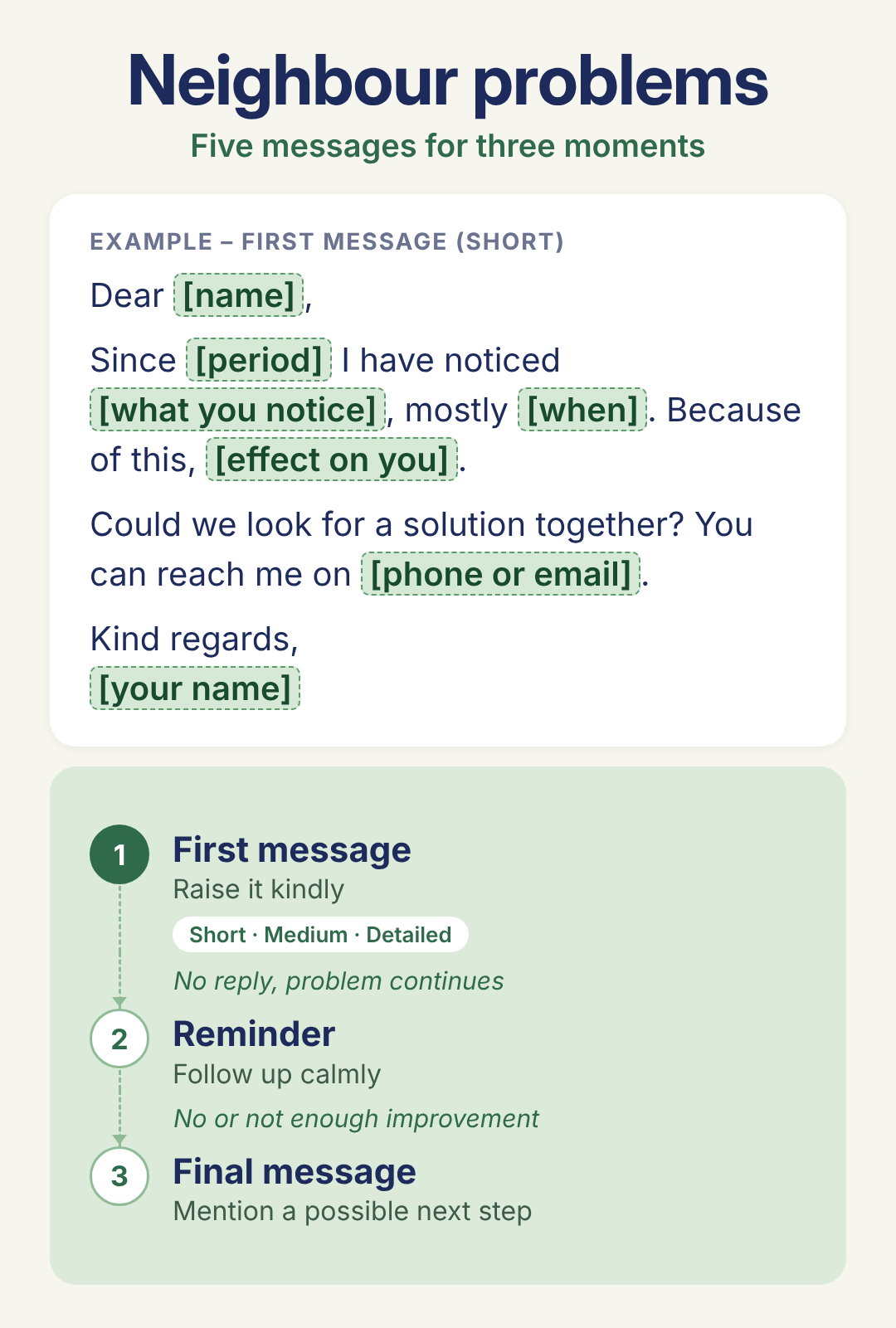
Five example messages: a first message in three lengths (short, medium and detailed), a reminder and a final message, a guide to choosing and using them, background information and UK context, and an incident diary (Word, plus a free Excel version).
The image shows a general example; the messages in the pack are tailored to this situation.
Why CalmNotes?
Based on experience with neighbour problems and community mediation
Focused on de-escalation
Ready to use straight away
Choose an appropriate step. If contact feels unsafe, seek help first.