
Rats and pests from next door
A rat along the fence, droppings by the shed or a burrow under the summerhouse: when you then see bird seed, bread or an open rubbish bag on the other side, it is tempting to join the dots. Yet you rarely know for sure where the animals come from, and your neighbours often have no idea that a habit of theirs is attracting anything.
Describe what you saw yourself and only mention a feeding spot if you have actually seen it. Don’t ask them to stop feeding the birds; ask for a different way: a hanging feeder with a catch tray, nothing left out overnight, rubbish in a closed bin and no cooked food on the compost heap.
The example messages and the incident diary help you talk this through calmly and keep track of what you agree. Rats take no notice of boundaries, so working together is what works best.
What do the rules say?
In the UK there is generally no law against feeding birds in your own garden. However, under the Prevention of Damage by Pests Act 1949 a council can require the owner or occupier of land to deal with rats or mice, and an accumulation of food or rubbish can in some cases be a statutory nuisance under the Environmental Protection Act 1990. Many councils offer pest control, sometimes for a fee. Rats that occur naturally in an area cannot simply be blamed on one neighbour.
How to approach it
1. Note the date, time and place of what you saw: an animal, droppings, gnaw marks, a burrow, and whether you saw a food source.
2. Send a friendly message with one specific suggestion, such as a hanging feeder and clearing up in the evening, and say what you will do yourself.
3. Agree a date to check together whether it helps, and if necessary get a pest controller in to take a look.
4. No change? The council’s pest control team, your landlord, the managing agent or a community mediation service can help.
Tips for your message
Don’t accuse; describe what you see. A sentence like ‘I saw two rats by the fence and there is bread on the ground; could we look together at how to give them less to eat?’ usually works better than ‘You are attracting rats’. Don’t put down poison or glue traps by the boundary yourself.
This is general information, not legal advice.

Pack
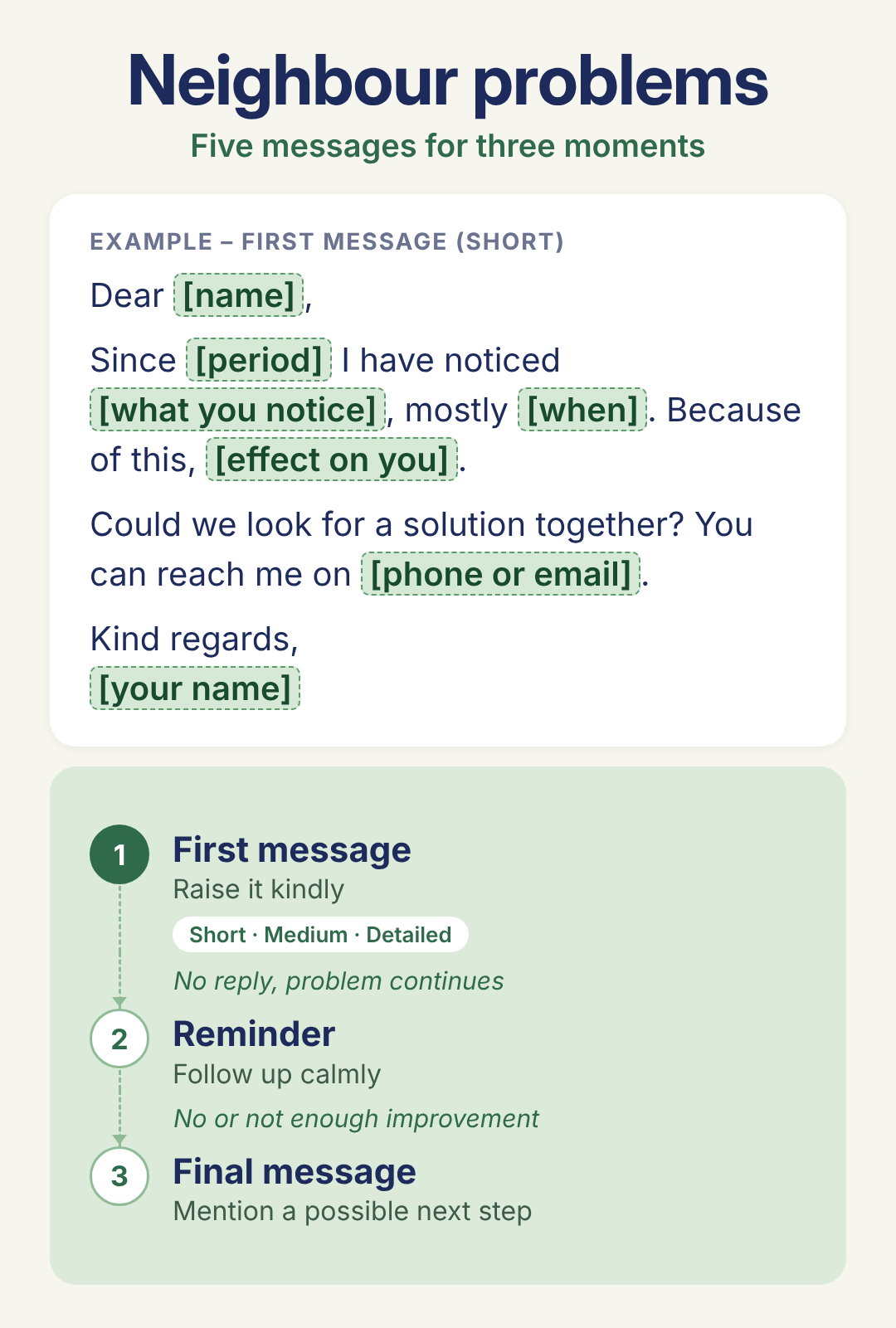
Five example messages: a first message in three lengths (short, medium and detailed), a reminder and a final message, a guide to choosing and using them, background information and UK context, and an incident diary (Word, plus a free Excel version).
The image shows a general example; the messages in the pack are tailored to this situation.
Why CalmNotes?
Based on experience with neighbour problems and community mediation
Focused on de-escalation
Ready to use straight away
Choose an appropriate step. If contact feels unsafe, seek help first.