
Loose or aggressive dog
A dog that suddenly appears in your garden, growls in the street or lunges at your own dog, or keeps escaping through a gap in the fence: to the owner it is often a lovely dog that only wants to play; to you it is unsettling because you don’t know how it will react.
Has someone been bitten, or is there immediate danger? Call 999 and get medical help first. Keep your distance from the dog and don’t try to correct it yourself. The conversation with your neighbours comes once everyone is safe.
The example messages and the incident diary help you talk this through calmly and keep track of what you agree. Describe what you saw, don’t label the dog and ask for something realistic: repairing the fence, a lead, a muzzle on walks or help from a dog trainer.
What do the rules say?
In England and Wales it is an offence under the Dangerous Dogs Act 1991 to let a dog be dangerously out of control, in public and also in a private place such as a neighbour’s garden; a dog counts as out of control if it injures someone or makes someone worried that it might. For less serious incidents, such as a dog straying or causing alarm, the police or council can issue a community protection notice requiring the owner to take steps. Scotland and Northern Ireland have their own rules.
How to approach it
1. Note the date, time, place and exactly what the dog did, and whether the owner was there. Photograph the gap in the fence.
2. Send a friendly message with one specific request, such as securing the fence and a lead in the street.
3. Agree a date to check together whether it works.
4. No change? Report straying or bites to the council, and to the police on 101 if someone was bitten; a community mediation service or the landlord can also help.
Tips for your message
Don’t accuse; describe what you saw. A sentence like ‘Yesterday Max came through the gap in the fence and growled at the children; could we look at the fence together?’ usually works better than ‘Your dog is aggressive’. Never try to correct or stop the dog yourself.
This is general information, not legal advice.

Pack
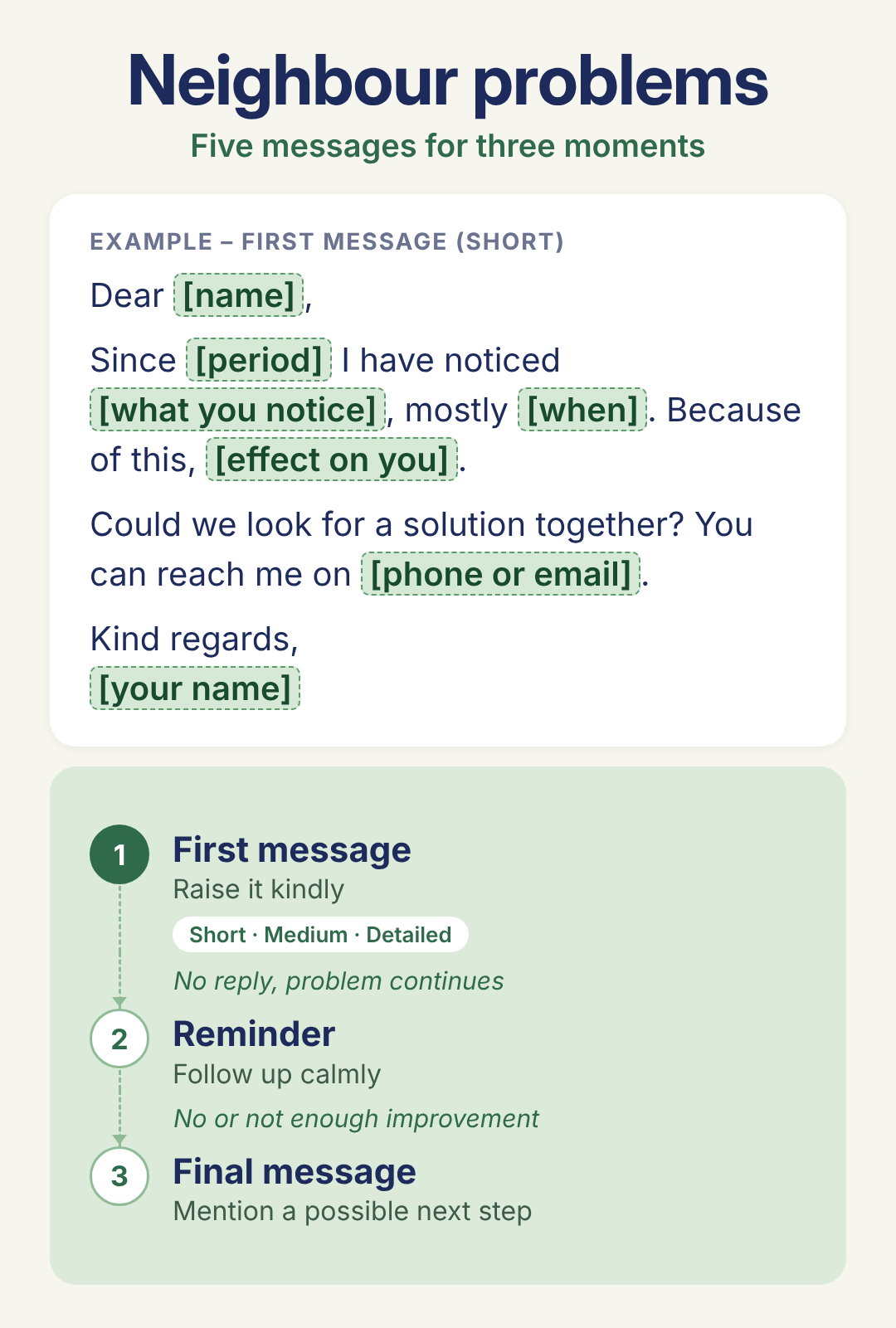
Five example messages: a first message in three lengths (short, medium and detailed), a reminder and a final message, a guide to choosing and using them, background information and UK context, and an incident diary (Word, plus a free Excel version).
The image shows a general example; the messages in the pack are tailored to this situation.
Why CalmNotes?
Based on experience with neighbour problems and community mediation
Focused on de-escalation
Ready to use straight away
Choose an appropriate step. If contact feels unsafe, seek help first.