
Charging cable, caravan and driveway
A charging cable across the pavement, a caravan that sits outside your window for weeks or a car blocking your driveway: this is about the public space in front of your home. To your neighbours the cable, caravan or car usually seems ordinary, and they don’t notice what it means on your side: a trip hazard, a blocked view and less light, or not being able to get out.
So describe what you see and what the effect is, and ask for one realistic change: a cable protector and taking the cable in after charging, the caravan to storage or a spot further along, or visitors keeping the driveway clear. Never move a car yourself and never unplug a cable.
The example messages and the incident diary help you talk this through calmly and keep track of what you agree. Only use facts you have seen yourself and leave room for what your neighbours need, such as charging at home or a place for the caravan.
What do the rules say?
In England and Wales, a trailing cable across the pavement may breach the Highways Act 1980, as government guidance on cross-pavement charging points out, and the person who lays it may be liable if someone trips; councils can allow cable channels set into the pavement. A trailer left on a road at night must be lit (Highway Code rule 250) and must not cause an obstruction. The Highway Code says not to park in front of an entrance to a property (rule 243), and where civil parking enforcement applies, councils can issue a penalty for parking across a dropped kerb, often at the resident’s request.
How to approach it
1. Note the date, time, duration and place, and take photos from the street; keep any registration number in your own incident diary only.
2. Send a friendly message with one specific suggestion, such as a cable protector, a set period for the caravan or a clear driveway.
3. Agree a date to check together whether it works.
4. Nothing changes? Report it to the council, contact parking enforcement or the police on 101 if your driveway is blocked, or try community mediation.
Tips for your message
Don’t accuse; describe what you see. A sentence like ‘My mother goes into the road with her walking frame because the cable lies across the pavement; could you use a cable protector?’ usually works better than ‘Your cable is dangerous’. Show that you have nothing against the electric car, the caravan or the visitors.
This is general information, not legal advice.
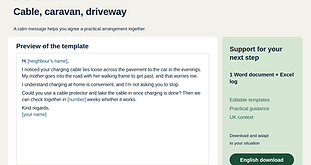
Pack
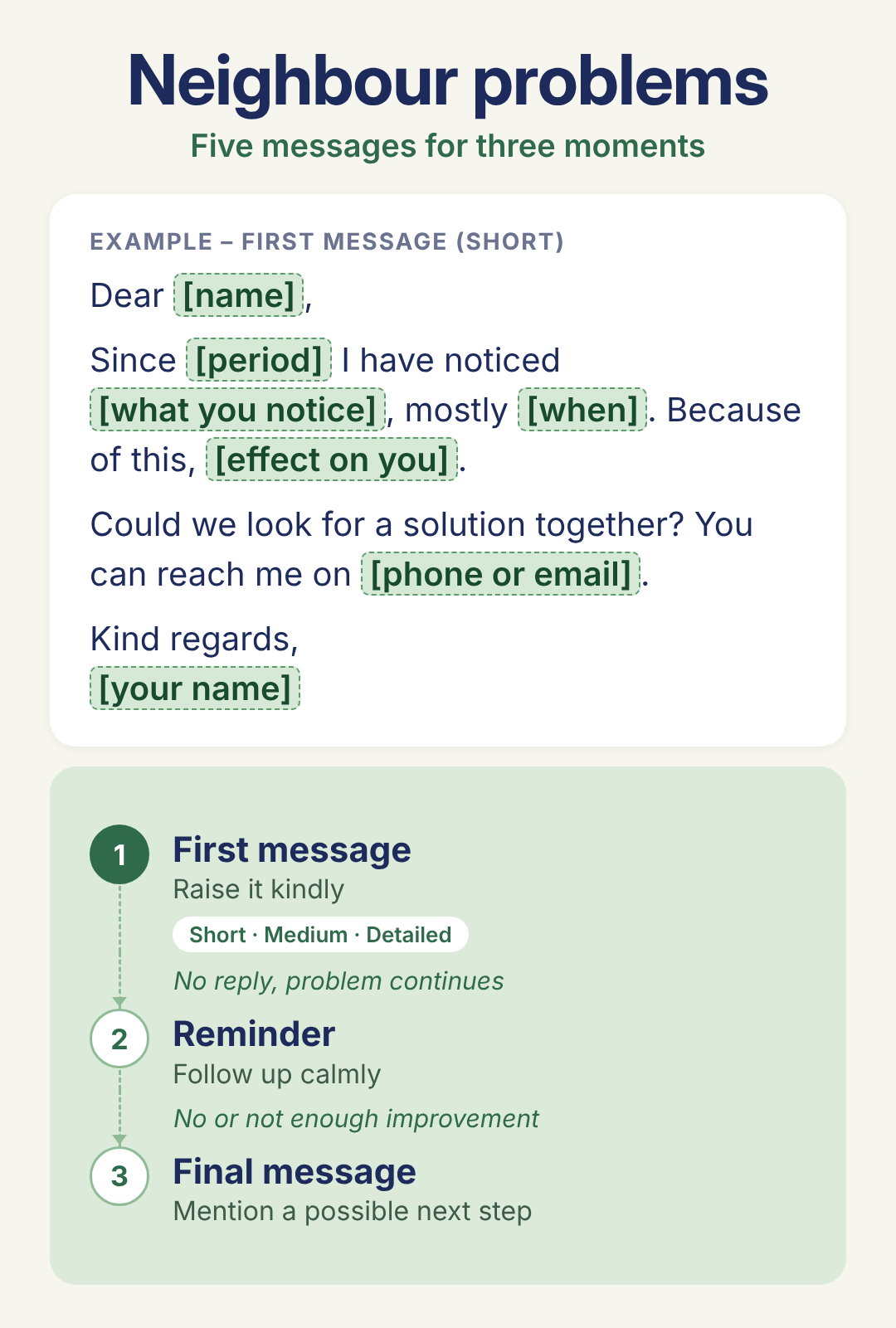
Five example messages: a first message in three lengths (short, medium and detailed), a reminder and a final message, a guide to choosing and using them, background information and UK context, and an incident diary (Word, plus a free Excel version).
The image shows a general example; the messages in the pack are tailored to this situation.
Why CalmNotes?
Based on experience with neighbour problems and community mediation
Focused on de-escalation
Ready to use straight away
Choose an appropriate step. If contact feels unsafe, seek help first.