
Trees and hedges blocking light
A hedge or tree grows gradually. Only when your patio is in shade in the afternoon, your kitchen stays dark or your solar panels produce less do you notice how tall it has become. From their own garden, your neighbours often don’t see it.
Describe what you see on your side: shade, leaves or needles in your gutters, or roots lifting the paving. Ask for something realistic, such as an agreed height and a regular trim, rather than removal.
The example messages and the incident diary help you talk this through calmly and keep track of what you agree. Only use facts you know and leave room for your neighbours’ interests, such as privacy.
What do the rules say?
In England and Wales, the high hedges rules (Part 8 of the Anti-social Behaviour Act 2003) cover a line of two or more mainly evergreen trees or shrubs over 2 metres high. After trying to settle it informally, you can complain to your council, which usually charges a fee and can require the hedge to be reduced, but not removed. Single trees are not covered. You may cut back roots and branches up to the boundary, unless the tree has a Tree Preservation Order or is in a conservation area, and an owner may be liable if roots damage your property.
How to approach it
1. Take dated photos from your own property a few times and note when and where the shade falls.
2. Send a friendly message with one specific suggestion, such as a height and a regular trim outside the nesting season.
3. Agree a date to check together whether it works.
4. Nothing changes? A community mediation service can help, and then a high hedges complaint to the council if the hedge qualifies.
Tips for your message
Don’t accuse; describe what you see. A sentence like ‘Since the hedge has grown so tall, our patio is in shade from three o’clock; could we agree a height together?’ usually works better than ‘Your hedge is far too high’. Never cut anything on your neighbour’s side.
This is general information, not legal advice.

Pack
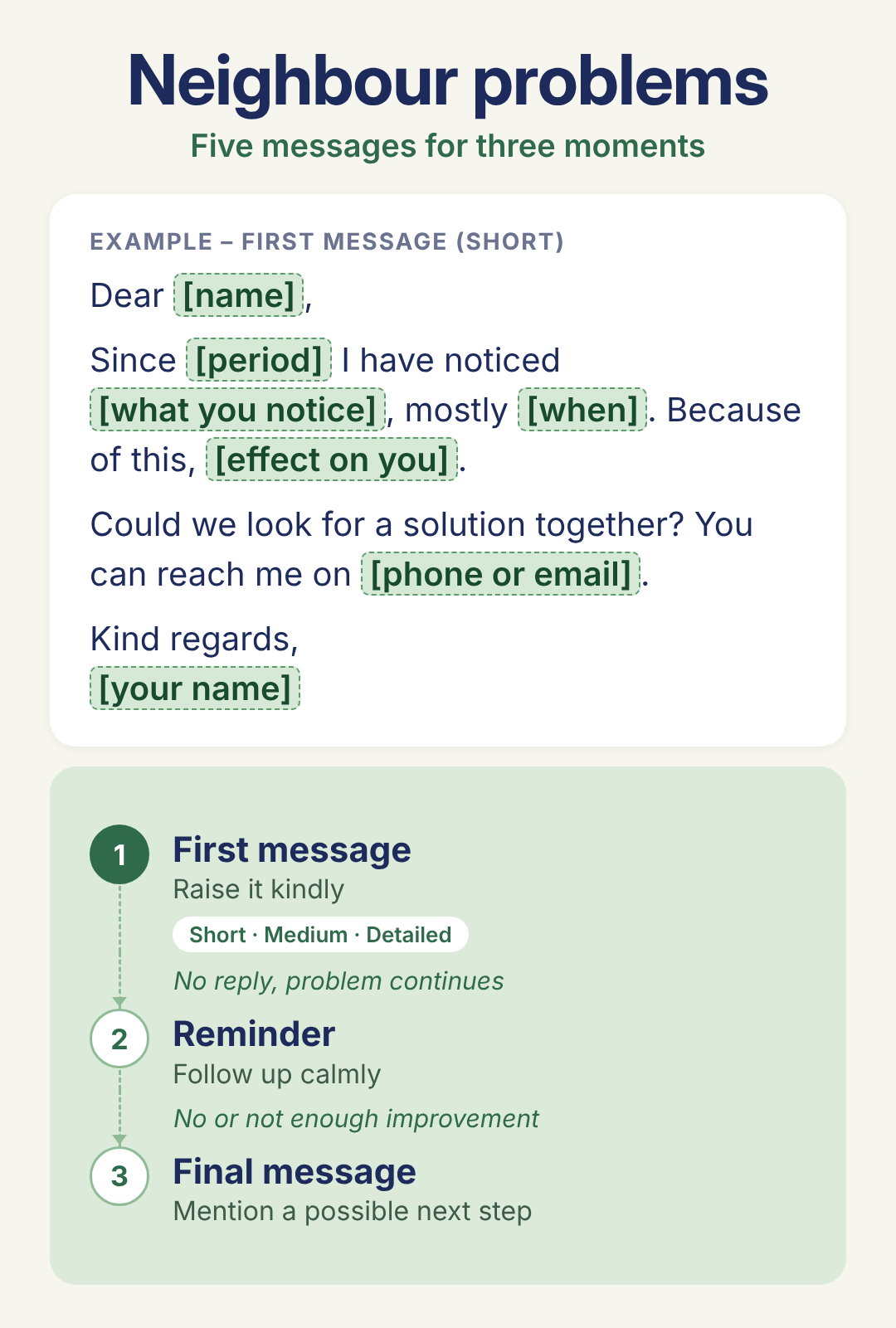
Five example messages: a first message in three lengths (short, medium and detailed), a reminder and a final message, a guide to choosing and using them, background information and UK context, and an incident diary (Word, plus a free Excel version).
The image shows a general example; the messages in the pack are tailored to this situation.
Why CalmNotes?
Based on experience with neighbour problems and community mediation
Focused on de-escalation
Ready to use straight away
Choose an appropriate step. If contact feels unsafe, seek help first.