
A neighbour’s cockerel and chickens
Keeping chickens in the garden is popular, and for many people a cockerel comes with it. But a cockerel that starts at five in summer disturbs your sleep, especially if the coop is close to your bedroom. The smell of a crowded coop, or rats and flies around the feed, can reach your side too.
Describe what you hear, smell or see: what time the crowing starts, where you notice the smell, what you see by the boundary. Ask for something realistic, such as a dark night-time coop, letting the birds out later or cleaning the coop more often, rather than asking for the birds to go.
The example messages and the incident diary help you talk this through calmly and keep track of what you agree. Only use what you have observed yourself and leave room for the enjoyment your neighbours get from their birds.
What do the rules say?
In the UK there is generally no rule against keeping a few chickens or a cockerel in an ordinary garden, although a tenancy agreement, lease or deeds may restrict animals, and poultry keepers in Great Britain must register their birds. Under the Environmental Protection Act 1990, noise and an animal kept in a way that causes a nuisance can be a statutory nuisance; the council looks at how early and how often the cockerel crows, how close the coop is and whether the area is rural or built-up.
How to approach it
1. For a few weeks, note what time the crowing starts and when you notice smell, flies or rats.
2. Send a friendly message with one specific suggestion, such as a dark night-time coop and a set time for letting the birds out.
3. Agree a trial period and then check together whether it helps.
4. No change? Community mediation can help, or your council’s environmental health team for smell and vermin.
Tips for your message
Don’t accuse; describe what you notice. A sentence like ‘Your cockerel has been starting at around five these last few weeks; could we look together at a darker coop?’ usually works better than ‘That cockerel has to go’. Never touch the birds or go into your neighbours’ garden.
This is general information, not legal advice.

Pack
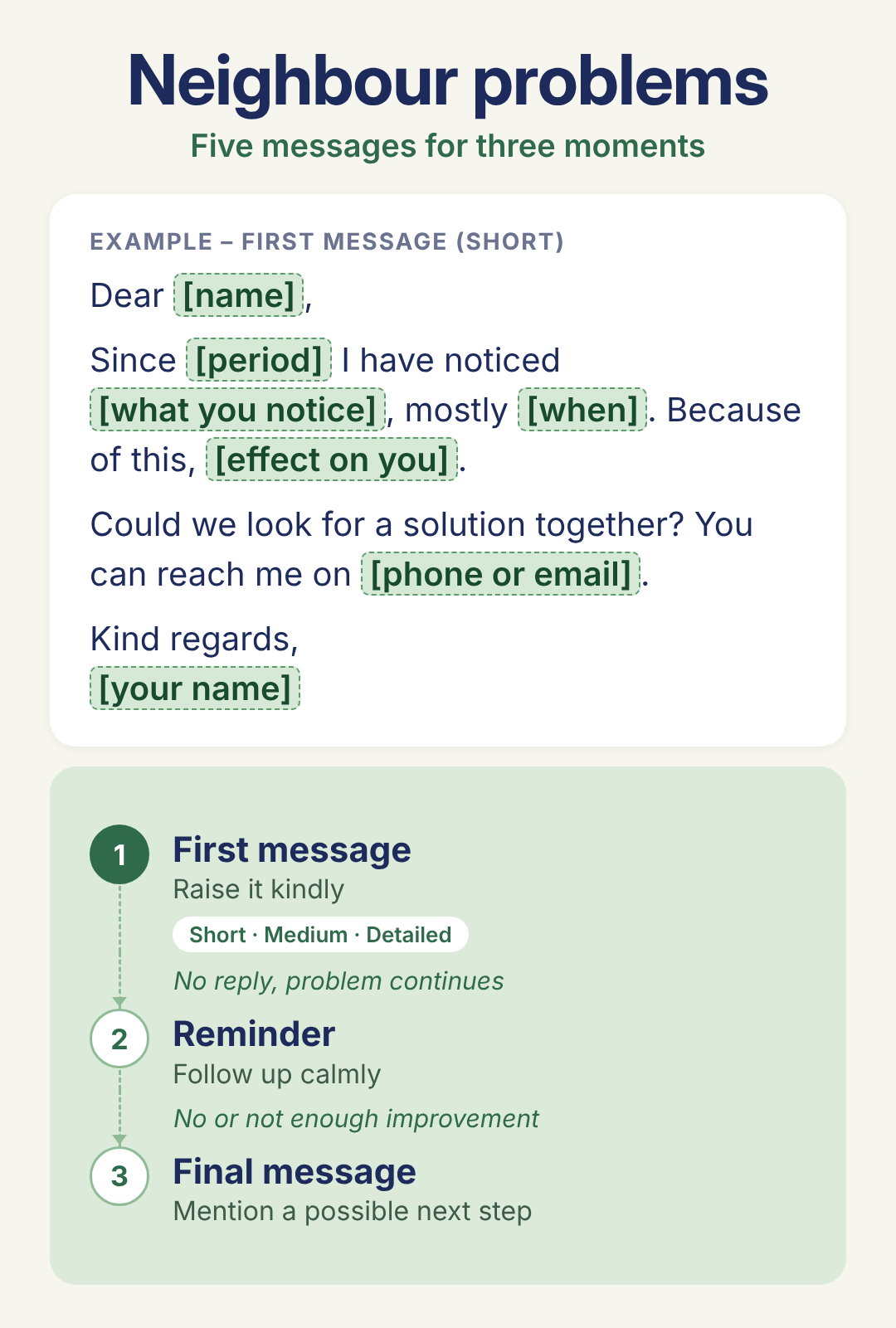
Five example messages: a first message in three lengths (short, medium and detailed), a reminder and a final message, a guide to choosing and using them, background information and UK context, and an incident diary (Word, plus a free Excel version).
The image shows a general example; the messages in the pack are tailored to this situation.
Why CalmNotes?
Based on experience with neighbour problems and community mediation
Focused on de-escalation
Ready to use straight away
Choose an appropriate step. If contact feels unsafe, seek help first.