
Building work and vibration
When your neighbours have building work done, you are often the one who notices it most: demolition, vibration, dust and site traffic, sometimes for weeks. A builder carries out the work, but your neighbours are the client and can ask the builder to take you into account.
Describe what you hear, feel and see yourself, and ask for specific arrangements: a schedule, a named contact, notice of heavy days and, before demolition or piling, a schedule of condition of your home.
The example messages and the incident diary help you talk this through calmly and record any disturbance or damage carefully. This page is about work by a building firm; if your neighbours are doing the work themselves, see DIY noise.
What do the rules say?
Many councils recommend that noisy building work takes place only from 8 am to 6 pm on weekdays and 8 am to 1 pm on Saturdays, and a council can set working hours for a site under the Control of Pollution Act 1974. In England and Wales, the Party Wall etc. Act 1996 covers work on shared walls and excavation near your foundations. Whether your neighbours or their builder are responsible for damage depends on the situation.
How to approach it
1. Before the heavy work, take photos of your walls and ask for a schedule of condition.
2. Send your neighbours a friendly message with one specific request, such as a schedule or a later start time.
3. Keep an incident diary and photograph any new cracks straight away, with the date.
4. No change? A community mediation service, the council or your home insurer can help.
Tips for your message
Don’t accuse; describe what you notice. A sentence like ‘We feel the demolition quite strongly in our kitchen early in the morning; could you ask your builder whether the heaviest work could start later?’ usually works better than ‘Your builders are far too noisy’.
This is general information, not legal advice.

Pack
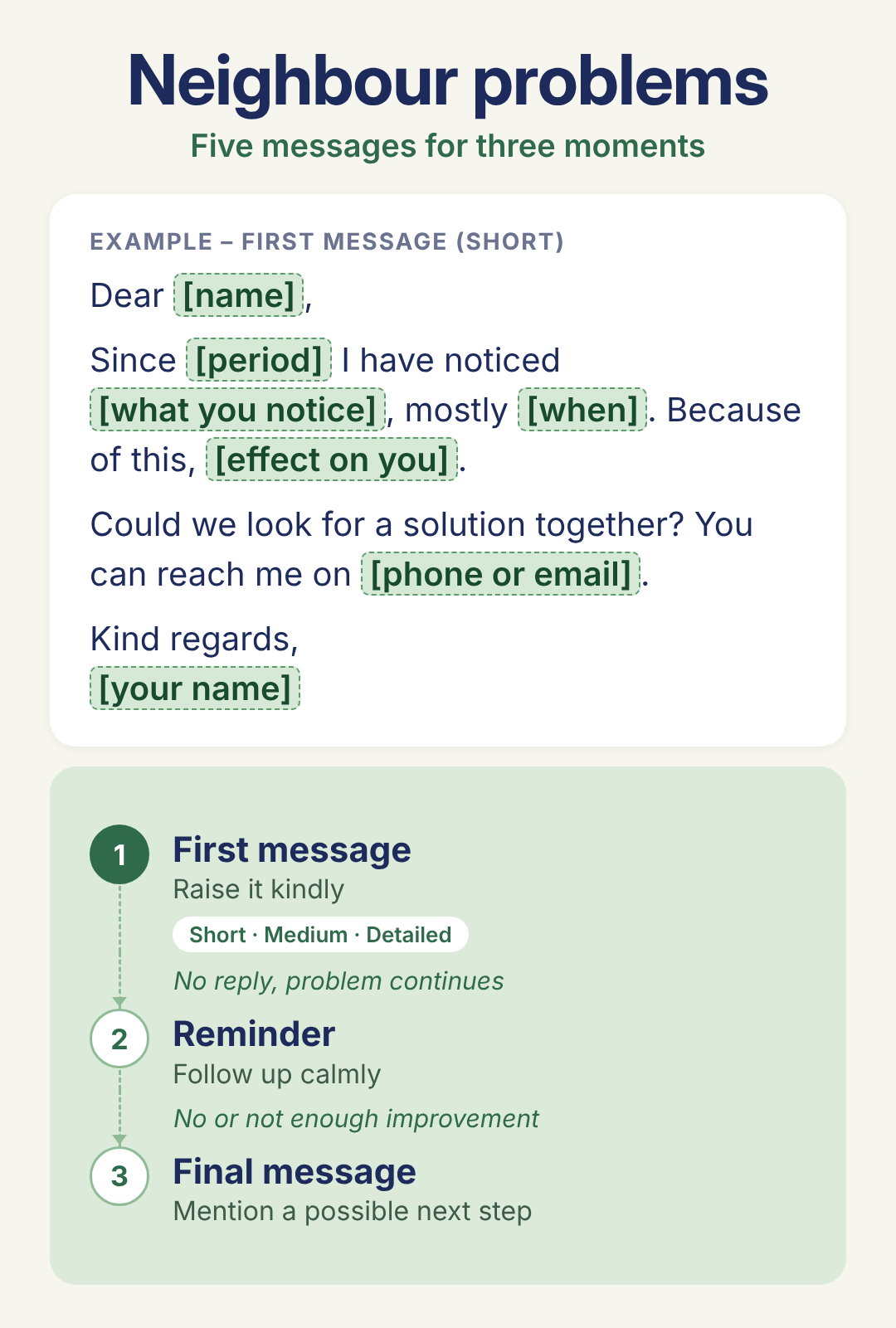
Five example messages: a first message in three lengths (short, medium and detailed), a reminder and a final message, a guide to choosing and using them, background information and UK context, and an incident diary (Word, plus a free Excel version).
The image shows a general example; the messages in the pack are tailored to this situation.
Why CalmNotes?
Based on experience with neighbour problems and community mediation
Focused on de-escalation
Ready to use straight away
Choose an appropriate step. If contact feels unsafe, seek help first.